Via Flora Ruchat-Roncati 15 (Campus SUPSI), 6850 Mendrisio
14.09.2026
Full Time (TP), from 3 years
BSc (Bachelor of Science)
180
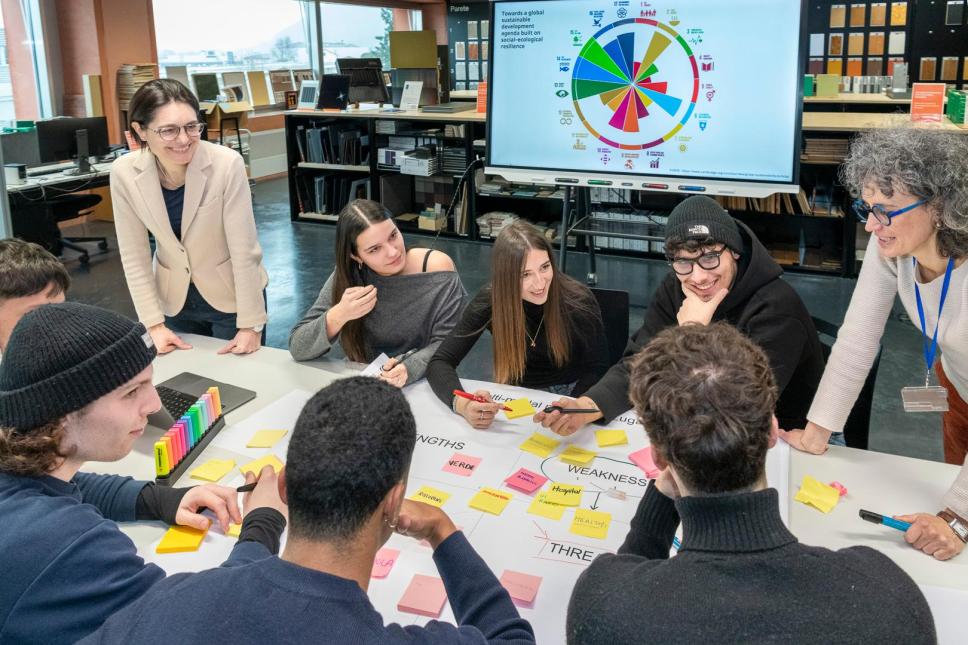
A new interdisciplinary, practice-oriented and strategic SUPSI programme designed to address the challenges of the transition towards a more equitable and inclusive, innovative and regenerative society. The new Bachelor of Science in Sustainability and Systemic Transition trains professionals capable of understanding the complexity of environmental, social and economic systems and of designing operational solutions to support individual and collective well-being.
Una nuova formazione SUPSI interdisciplinare, concreta e strategica per affrontare le sfide della transizione verso una società più equa e inclusiva, innovativa e rigenerativa. Il nuovo Bachelor of Science in Sostenibilità e transizione sistemica forma professioniste e professionisti capaci di leggere la complessità dei sistemi ambientali, sociali ed economici e di progettare soluzioni operative a sostegno del benessere individuale e collettivo.
Ein neues interdisziplinäres, praxisorientiertes und strategisches Studienprogramm der SUPSI, das darauf ausgelegt ist, die Herausforderungen des Übergangs zu einer gerechteren, inklusiveren, innovativeren und regenerativen Gesellschaft zu bewältigen.
Der neue Bachelor of Science in Nachhaltigkeit und systemischer Transformation bildet Fachkräfte aus, die in der Lage sind, die Komplexität ökologischer, sozialer und wirtschaftlicher Systeme zu verstehen und praxisnahe Lösungen zu entwickeln, um das individuelle und kollektive Wohlbefinden zu fördern.
Language: Italian, English
Sede: Mendrisio, Campus SUPSI and Manno, stabile Piazzetta
Why choose this Bachelor?
The Bachelor will provide a solid and interdisciplinary preparation to implement practical actions that are deeply rooted in the values and ethics of sustainability.
The Sustainability Transition Coordinator will be able to operate in a systemic and cross-cutting way, contributing to the concrete implementation of sustainability strategies and measures in the public, private or third sector.
A Bachelor's degree accessible through different educational paths
Applicants holding a diploma from the Scuola cantonale di commercio di Bellinzona or a professional baccalaureate obtained in Switzerland or equivalent are admitted directly, subject to available places and according to a ranking drawn up through an aptitude interview.
Competences and prospects
Models, contexts and systems
Data collection and analysis
Impact assessment and mitigation
Design and management of sustainability measures
Attitude and relationship
Professional profile and career opportunities
The skills developed respond to a growing demand for professionals capable of integrating environmental, social and economic dimensions into decision-making and operational processes in public, private and non-profit contexts. Sustainability Transition Coordinators graduating from this Bachelor are professionals able to contribute to the analysis, design and implementation of transformative policies, projects and interventions, adopting a systemic, collaborative and impact-oriented approach.
Graduates will be able to:
Thanks to a programme that combines theoretical foundations, operational tools and concrete applications through laboratories, internships and practice-oriented theses, graduates will be able to enter a wide range of professional contexts, both as employees and as external collaborators, contributing in a conscious and qualified manner to the concrete implementation of sustainability strategies and measures.
Graduates will be able to bring their transversal skills and transformative capacities into various professional roles, such as:
The 3rd year will offer the opportunity to enhance individual aptitudes and facilitate entry into the labour market through in-depth courses aimed at developing operational professionalism for specific contexts, such as public bodies, service companies, industries or non-profit organisations.
Teaching methods
Until Wednesday, September 30, 2026, it is possible to apply in the 2026–2027 professional practice year (preparatory year) – starting in October 2026 – intended for applicants who do not meet the requirements for direct admission to the Bachelor’s program.
To apply to the professional practice year, please follow the indications published in the official webpage: https://www.supsi.ch/en/bachelor-sustainability-and-systemic-transition?p_p_state=pop_up&p_p_supsi_state=modal